
To make an AI agent predictable in both cost and outcome, you have to move where the model reasons: do it once, when the workflow is designed, not at every execution. That is the principle of Pega’s Predictable AI architecture. It also enables the outcome-based pricing model introduced with Pega Infinity 26. Here is how it works, what it changes for governance, and the points to check before scaling.
The enterprise AI divide is no longer about access to models but about execution. And in execution, one word now matters more than any other: predictable. Predictable costs, and predictable outcomes.
In short
- 3 risks: operational, financial, architectural.
- An agent that reasons at every call costs more and answers identical requests differently.
- Pega has AI reason at design time, then executes approved workflows.
- Since Pega Infinity 26: per-case pricing, no token or seat fees.
- Rules, audit and cost ceilings are built into the process.
Why do AI agents have a predictability problem?
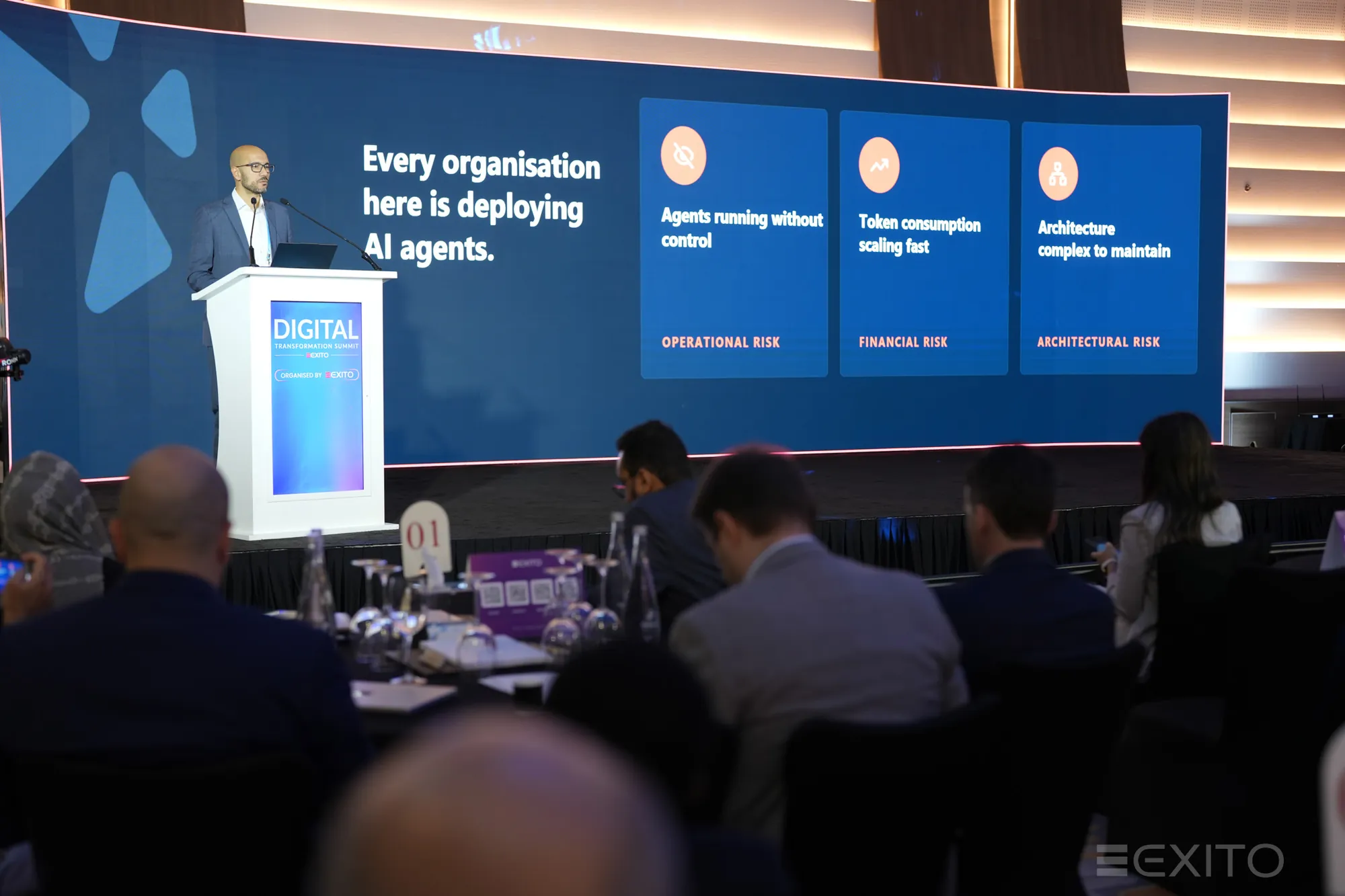
AI agents are multiplying faster than organisations’ ability to govern them. Many companies have dozens in production, and few can give the exact number. That is already part of the problem. In the field, three risks come up in every project:
The financial risk is structural. According to a Gartner forecast from March 2026, agentic models consume 5 to 30 times more tokens per task than a standard chatbot (CustomerThink). A 2025 MIT NANDA study also estimated that 95% of generative AI pilots delivered no measurable return on the bottom line.
None of these risks depends on the choice of LLM. They depend on how the model is orchestrated.
What is predictable AI?
Predictable AI gives the same answer to two identical requests, at a cost known in advance. Two people with the same problem must get the same decision, whatever the day or the wording.
“We want AI to be predictable and reliable, so that two people whose problem is fundamentally the same don’t get different answers.”
Take a bank. Two customers apply for the same loan, with the same profile and the same supporting documents. If the agent reasons freely on every request, one may be approved and the other declined, simply because the model took a different path that day.
In a regulated sector, this is not a technical bug. It is a compliance and reputational risk: creditworthiness assessment is one of the uses classified as high-risk by the EU AI Act, which requires traceability and human oversight. Consistency is not a luxury: it is the licence to operate.
Why AI governance must be built in from design
Governance added afterwards does not control AI: it reacts to its mistakes. The usual reflex is to add a kill switch, a control tower or a monthly review board. A kill switch that fires means an incident has already happened.
Real governance does not sit next to the process: it lives inside it.
| After-the-fact governance | Governance by design | |
|---|---|---|
| Where the rules are | In policies outside the process | In the workflow, executed at every step |
| Audit | Post-incident review | Every step traced natively |
| Costs | Discovered on the bill | Capped before execution |
| Typical tools | Kill switch, control tower, review board | Case types, decision rules, case history |
| Result | An illusion of control | Control that holds in production |
The real shift: intelligence becomes abundant, predictability becomes rare
Intelligence is becoming a commodity. Predictability is becoming the premium resource. Any organisation can now access a frontier model, and so can its competitors. That is no longer what sets them apart.
What is rare is getting the same right answer every time, at a cost agreed in advance. The model race does not solve this: a more powerful model reasons better, it does not reason more consistently.
The differentiator therefore shifts from the model to what surrounds it.
The harness around the model: workflows, rules, data, audit
Enterprise AI needs a harness: the model stays powerful, but it is directed. This harness has four components, each carried by existing Pega building blocks:
Beyond Pega, Agentic Process Fabric registers the agents, workflows and data of Pega applications and third-party systems. It supports the MCP (Model Context Protocol) and A2A (Agent-to-Agent) protocols. Pega processes can therefore be called by agents from Anthropic, OpenAI, Google or AWS, while remaining under Pega’s governance controls.
Pega Predictable AI: reason at design time, execute at run time
The decisive architecture choice is when the model reasons. Most AI agents start from scratch at every execution. The same question asked on Monday and again on Tuesday is thought through twice: you pay twice, and you may get two different answers.
Pega separates the two moments (Pega Agentic Process Fabric press release):
- At design time. The expensive reasoning happens once, when the workflow is created. The design agents in Pega Blueprint and Pega Infinity Studio propose the process steps, data, roles and rules. Business and IT teams validate them. This is where AI earns its cost.
- At run time. A lighter “semantic” mode identifies the user’s intent. The agent selects the matching approved Pega workflow and follows it step by step.
- Bounded LLM calls. When a step needs a language model (reading a document, summarising a customer history), it receives precise, limited instructions, not open latitude.
This single architecture decision has two effects. Outcomes become reproducible, because two identical requests take the same path. Costs become predictable, because reasoning is not repeated at every execution.
Pricing per case rather than per token: what changes with Pega Infinity 26
With Pega Infinity 26, announced on 8 June 2026 and available in Q3 2026, Pega agents are priced per case resolved, with no token or seat fees (Agile Brand Guide). A case is a task executed end to end: a customer changing an order, a loan application, an insurance claim. The price stays the same whatever the amount of AI used behind the scenes.
This is not an opportunistic pivot. Pega has been orchestrating business processes since 1983, long before anyone talked about “agentic” AI. Per-case pricing is the economic consequence of this architecture, not just a commercial choice.
This model is only sustainable because reasoning is not wasted. A vendor whose agents burn tokens rethinking the same process cannot commit to a fixed price per outcome. Pega claims savings that can exceed 20 times the costs of a token-priced approach, depending on complexity and volume. This figure comes from its own simulator, the AI Token Cost Calculator, and has not been independently verified.
The market is converging on outcome-based pricing, but the billing unit varies (CustomerThink):
| Vendor | Billing unit | Announced public price |
|---|---|---|
| Pega Infinity 26 | Case resolved | Flat fee per case, under contract |
| Salesforce Agentforce | Conversation, then action (Flex Credits) | .00 per conversation at launch |
| Zendesk | Automated resolution | About .50 on committed volume |
| Intercom Fin | Resolution | /bin/bash.99 |
| HubSpot | Resolved conversation | /bin/bash.50 since April 2026 |
The difference lies in the unit. A support “resolution” covers one conversation. A Pega case covers a complete business process, often multi-step and multi-system.
For development teams, Pega Infinity 26 also brings a unified studio and an AI Assistant: we cover them in our article on the new AI features of Pega Infinity ‘26.
Questions to ask before scaling
The Predictable AI architecture delivers on its promises when the scope of workflows is well defined. The grey areas are at the edges. Before signing or industrialising, four points deserve clarification:
These are design questions as much as contract questions. They are addressed during process mapping, not after deployment.
What the analysts say
In 2026, two independent analysts named Pega a Leader, from two different angles.
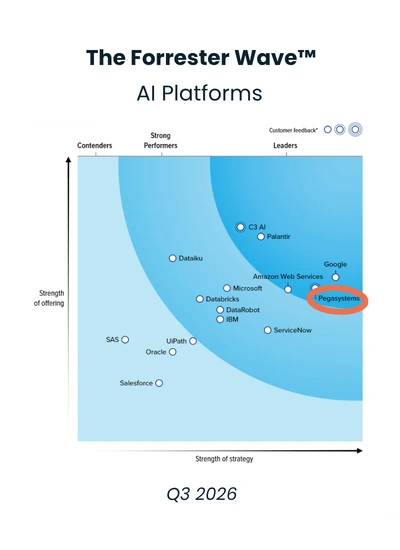
Forrester Wave™: AI Platforms, Q3 2026
Pega is a Leader, with the top score in 8 of 19 criteria, including agent development and governance.
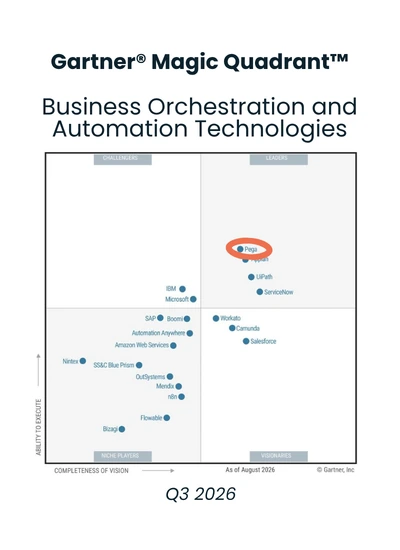
Gartner Magic Quadrant 2026: BOAT
Pega is a Leader for the second consecutive year, according to the vendor's announcement.
One analyst evaluates AI platforms, the other process orchestration. Both reach the same conclusion: the value lies in the orchestration layer, not in the model alone.
Frequently asked questions
What is Pega Predictable AI?
Pega Predictable AI is Pega's AI agent architecture. The model's reasoning happens when workflows are designed, in Pega Blueprint and Infinity Studio. At run time, agents execute approved workflows instead of reasoning again for every request.
Why does a conventional AI agent cost so much?
A conventional agent reasons at every execution. The more complex the request, the more reasoning steps it chains and the more tokens it consumes. According to Gartner, an agentic model uses 5 to 30 times more tokens per task than a standard chatbot.
How does Pega price its AI agents?
Since Pega Infinity 26, Pega prices its agents per case resolved. There are no token fees and no seat fees, and the price of a case does not depend on how much AI is used.
What is AI governance by design?
It is governance built into the process rather than added afterwards. Business rules are executed in the workflow, every step is traced, and cost ceilings are set before execution.
Does Pega work with agents from other vendors?
Yes. Pega Agentic Process Fabric supports the MCP and A2A protocols. Third-party agents can call Pega processes, under the platform's governance controls.
Why does predictability matter more than model power?
Every company has access to the same frontier models, so model power no longer sets anyone apart. What remains rare is getting the same right answer every time, at a cost known in advance. That is what business teams and regulators require.
The question is no longer whether to adopt AI, but whether you can trust it
Most companies have already decided to adopt AI. The remaining question is whether they can trust it: do they get reliable outcomes, at a cost they can forecast? That is not a model question. It is an orchestration question.
Watch: predictable costs and outcomes with Pega
The key points of this article on video, presented by Riadh Ziri, CEO of IRIZ Consulting:
Deploying AI agents and want to control your costs and outcomes?
IRIZ Consulting's Pega experts support you, from mapping your processes to designing governed agentic workflows in Pega Infinity.
Let's talk: book a meeting →Sources
- Pega Eliminates ‘AI Token Tax’ With More Efficient Way to Build and Run Agentic Workflows, Agile Brand Guide, June 2026
- Pega’s fix for runaway AI costs: stop the agents from thinking at runtime, CustomerThink, 24 June 2026
- Pega Agentic Process Fabric Reliably Orchestrates End to End AI Automation, Business Wire, June 2025
- Pega Named a Leader in AI Platforms by Independent Research Firm, Business Wire, August 2026
- Pega named Gartner Leader in AI orchestration for second year, ScanX, September 2026
- Pega Named a Leader in Gartner Magic Quadrant for BOAT (2025), Business Wire, October 2025